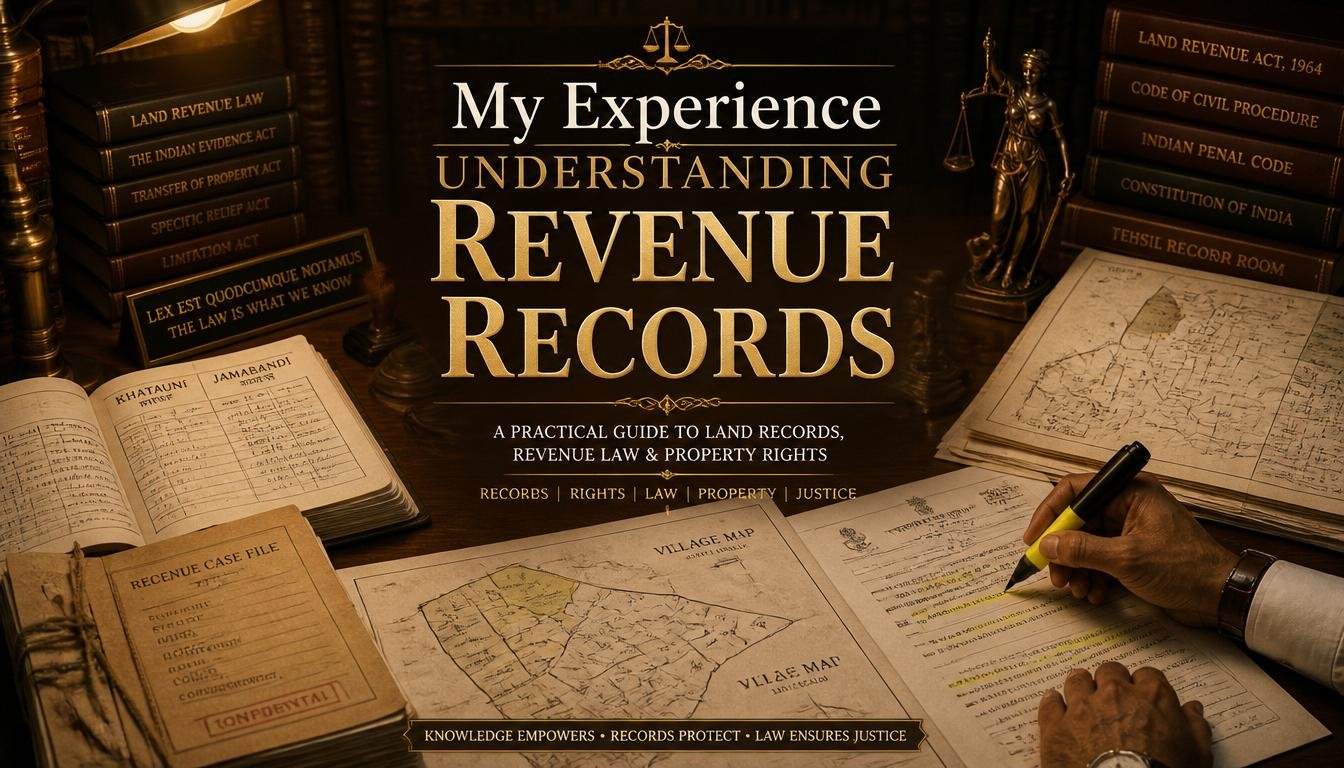
Revenue records seemed like dry government paperwork until I had to actually rely on them to protect my property rights. What I discovered through that process changed how I view land documentation entirely. This article walks through everything I learned about revenue records, why they matter so much in land law, and how understanding them can save you from costly disputes.
What Are Revenue Records?
Revenue records are official government documents maintained by local revenue departments that track land ownership, possession, cultivation status, and tax liability for a given piece of property. Unlike title deeds, which are legal instruments of transfer, revenue records serve as administrative documentation used primarily for taxation, land management, and dispute resolution.
These records go by different names depending on the region, Jamabandi, Khasra, Khatauni, Record of Rights (ROR), or simply the land register. Despite the varying terminology, their core purpose remains consistent: providing an official, continuously updated account of who holds, occupies, or has rights over a specific parcel of land.
When I first encountered these terms, I assumed they were interchangeable with ownership documents. That assumption nearly cost me during a property dispute, and it’s the first major lesson I want to share.
My First Encounter With Revenue Records:
My introduction to revenue records came when I was helping a family member resolve a boundary dispute over ancestral agricultural land. We had a decades-old sale deed, but when we approached the local Patwari (village-level revenue official) for clarification, I learned the revenue record told a completely different story than what we expected.
The Khasra showed different boundary measurements than our deed, and the Khatauni listed a co-owner we hadn’t accounted for. This discrepancy forced me to dig deeper into how revenue records are maintained, updated, and legally interpreted, and that research became the foundation of everything I now understand about land documentation.
The Different Types of Revenue Records:
Through extensive research and firsthand experience, I learned that revenue records generally fall into a few key categories:
1. Record of Rights (ROR):
The Record of Rights, often called Jamabandi, is the master document listing the owner, occupant, or cultivator of a specific land parcel. It’s periodically updated, sometimes every few years, and reflects the most current recognized possession and ownership status.
2. Khasra (Field Register):
The Khasra is a field-level document recording details about individual land parcels, including survey numbers, boundaries, area measurements, and crop or land use information. This was the document that revealed the boundary discrepancy in my family’s case.
3. Khatauni (Ownership Register):
The Khatauni links individual landholders to their respective Khasra numbers, essentially serving as an index of who owns what within a given village or area. It was through the Khatauni that we discovered the unaccounted co-owner.
4. Mutation Register:
Closely tied to revenue records, the mutation register tracks changes in ownership over time, recording transfers due to sale, inheritance, or partition. I had previously learned how critical this document is when dealing with mutation entry during a separate property transaction.
5. Survey Settlement Records:
These are historical documents created during formal government land surveys, establishing baseline boundaries, measurements, and classifications that later records build upon. Older disputes, like the one my family faced, often trace back to discrepancies in these original settlement records.
Why Revenue Records Matter So Much:
Reflecting on my experience, here’s why I now consider revenue records absolutely essential in any land-related matter:
They Establish Possession History:
Revenue records track who has historically occupied or cultivated a piece of land, which courts often consider important evidence in ownership disputes, even when formal title documents are incomplete or contested.
They Determine Tax Liability:
Local governments use revenue records to assess and collect property tax and land revenue, meaning outdated or incorrect records can result in tax notices being sent to the wrong person entirely.
They Support Loan and Mortgage Applications:
Just as I learned with mutation records, banks frequently require updated revenue records before approving a loan against land or an agricultural mortgage, since these documents help verify current ownership and possession status.
They Reveal Hidden Disputes or Claims:
In my family’s case, the revenue record exposed an additional co-owner that wasn’t mentioned anywhere in our sale deed. Without checking these records, we would have remained unaware of a significant legal complication.
They Provide Evidentiary Support in Court:
While revenue records alone don’t establish conclusive title, courts treat them as strong supporting evidence, particularly when combined with consistent possession, tax payment history, and other corroborating documents.
The Process of Verifying Revenue Records:
Based on what I learned, here’s the general approach I now recommend for anyone trying to verify revenue records before a land transaction:
- Identify the correct jurisdiction: Revenue records are maintained at the Tehsil, Patwari circle, or local revenue office level, so knowing the correct office is essential.
- Request the latest Jamabandi or ROR: This gives you the most current recognized ownership and possession status.
- Cross-check the Khasra and Khatauni: Comparing field measurements and ownership indexes can reveal inconsistencies, just as it did in my case.
- Review the mutation history: Checking past mutation entries helps confirm a clean, traceable chain of ownership.
- Verify with the local Patwari or revenue official: In many regions, physical verification by the local official remains the most reliable way to confirm a record’s accuracy.
- Cross-reference with the sale deed and survey records: Any discrepancies between these documents should be resolved before finalizing a transaction.
This process, while time-consuming, is far less costly than discovering a hidden dispute after a purchase or inheritance has already been finalized.
Common Discrepancies I Encountered:
Through my own experience and conversations with property lawyers, I learned that discrepancies in revenue records are far more common than most people assume. Some of the most frequent issues include:
- Outdated ownership entries that don’t reflect recent sales, inheritance, or partition.
- Boundary mismatches between the Khasra and actual physical measurements on the ground.
- Unrecorded co-owners, especially in cases involving ancestral or inherited property.
- Clerical errors in spelling names, survey numbers, or area calculations.
- Pending mutation entries that leave records temporarily inconsistent with actual ownership status.
Recognizing these patterns helped me approach every subsequent property matter with far more caution and thoroughness.
How Revenue Records Differ From Title Documents:
One of the most important distinctions I had to internalize is that revenue records are not the same as title documents. A sale deed, gift deed, or court decree legally transfers ownership rights, while revenue records are administrative documents that reflect, but don’t independently create, that ownership.
This distinction matters enormously in legal disputes. Courts have consistently held that revenue entries are not conclusive proof of title, but they remain highly persuasive evidence, especially when no party can produce stronger documentation. Understanding this balance helped me see why both title documents and revenue records need to be verified together, not in isolation.
Lessons for Anyone Dealing With Land Transactions:
Looking back on my journey understanding revenue records, here’s what I’d tell anyone navigating a similar situation:
- Never rely solely on a sale deed without cross-checking the corresponding revenue records.
- Always request the most recent and updated versions of Jamabandi, Khasra, and Khatauni, since older copies may not reflect recent changes.
- Treat discrepancies seriously, even small clerical errors can escalate into significant legal disputes if left unresolved.
- Build a relationship with a knowledgeable local revenue official or property lawyer who understands regional record-keeping practices, since these vary significantly between states and districts.
- Keep your own personal records updated and organized, including mutation certificates, tax receipts, and survey documents, to simplify future verification.
Final Thoughts:
Understanding revenue records transformed how I approach land law entirely. What initially seemed like bureaucratic paperwork turned out to be one of the most important tools for protecting property rights, resolving disputes, and ensuring clean, traceable ownership. Whether you’re buying, inheriting, or simply safeguarding family property, taking the time to understand and verify revenue records is a step no one involved in land transactions should skip.
FAQs:
1. What are revenue records in land law?
They are government documents tracking land ownership, possession, and tax liability.
2. Are revenue records the same as title deeds?
No, title deeds legally transfer ownership while revenue records administratively reflect it.
3. What is the Jamabandi?
It’s a Record of Rights document showing current ownership and possession of land.
4. Why are revenue records important in property disputes?
They provide strong supporting evidence of possession and ownership history in court.
5. How can I verify revenue records before buying land?
Cross-check the Jamabandi, Khasra, and Khatauni with the sale deed and mutation history.
6. What common errors appear in revenue records?
Outdated entries, boundary mismatches, and unrecorded co-owners are the most frequent issues.